Hydroxy Monomers for Adhesives and Polymer Modification
What these monomers do in structural and non-structural adhesive systems, and where they are used to modify an existing polymer.
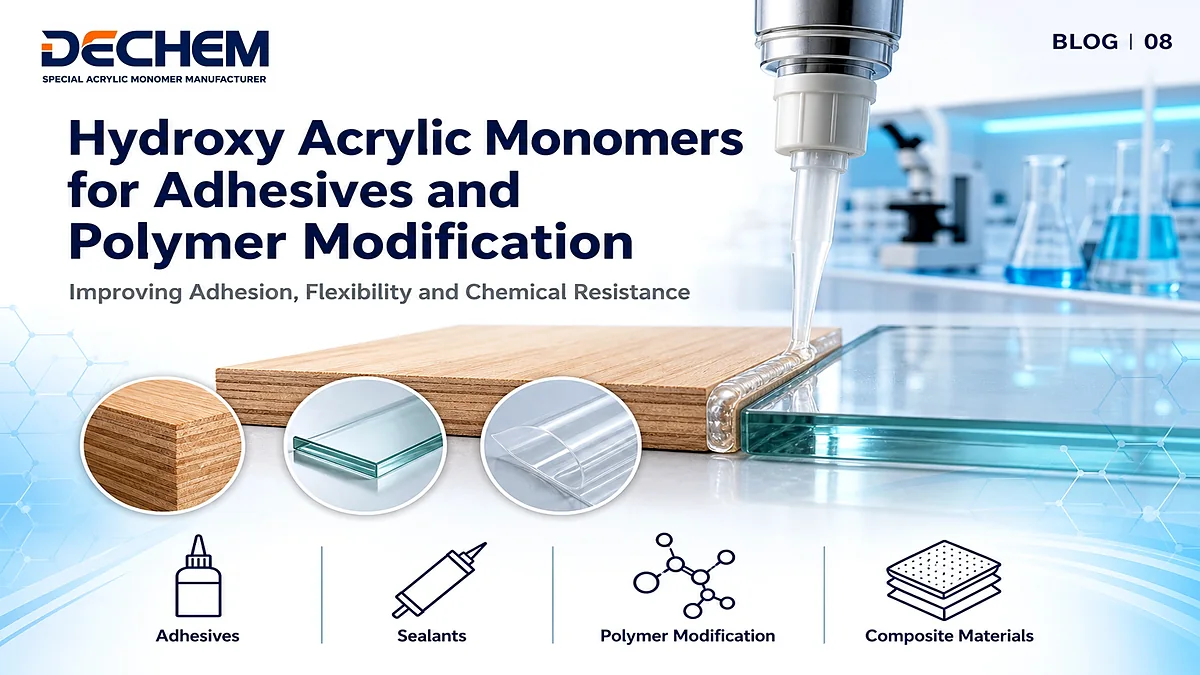
Hydroxyl functionality is useful in two different ways: it enables crosslinking in a newly built system, and it allows an existing polymer to be extended or modified.
In adhesive systems
Hydroxy-functional monomers are widely used in adhesive and sealant formulations for several reasons. They improve bonding strength because the hydroxyl group participates in the crosslinking network. They improve flexibility, which matters when the bond line has to survive movement of the bonded parts. And they improve crosslinking performance, allowing a formulation to reach a higher crosslink density without losing toughness.
For structural applications, the chemistry is typically combined with isocyanate hardeners. For non-structural and assembly adhesives, the same functionality is used at lower crosslink density and often with a different curing mechanism.
In polymer modification
The same hydroxyl group allows an existing polymer to be extended. By functionalising a base polymer with a hydroxy-functional monomer, chain length and hydroxyl content can be increased, and the modified polymer can then be crosslinked or grafted further.
This is a common route for upgrading an existing resin grade without replacing the whole formulation: the base polymer is retained, and the modification is achieved through a controlled addition step.
Selecting for adhesive work
When the adhesive is the primary requirement, the decision usually comes down to flexibility versus cure speed. 2-HPA is typically the flexible option. 2-HEA is typically the fast-curing, harder option. HEMA and HPMA sit on the methacrylate side, adding hydrolysis and weather resistance where the bond line will see moisture or outdoor exposure.
Practical notes
The TDS for the chosen grade gives the hydroxyl value, which is the number that matters for crosslinker calculation. The safety data sheet governs handling. For export documentation, the REACH file for the relevant monomer is available on the product page.