How to Select a Reliable Hydroxy Acrylic Monomer Supplier
A practical checklist for evaluating a monomer supplier before you commit a production programme to them.
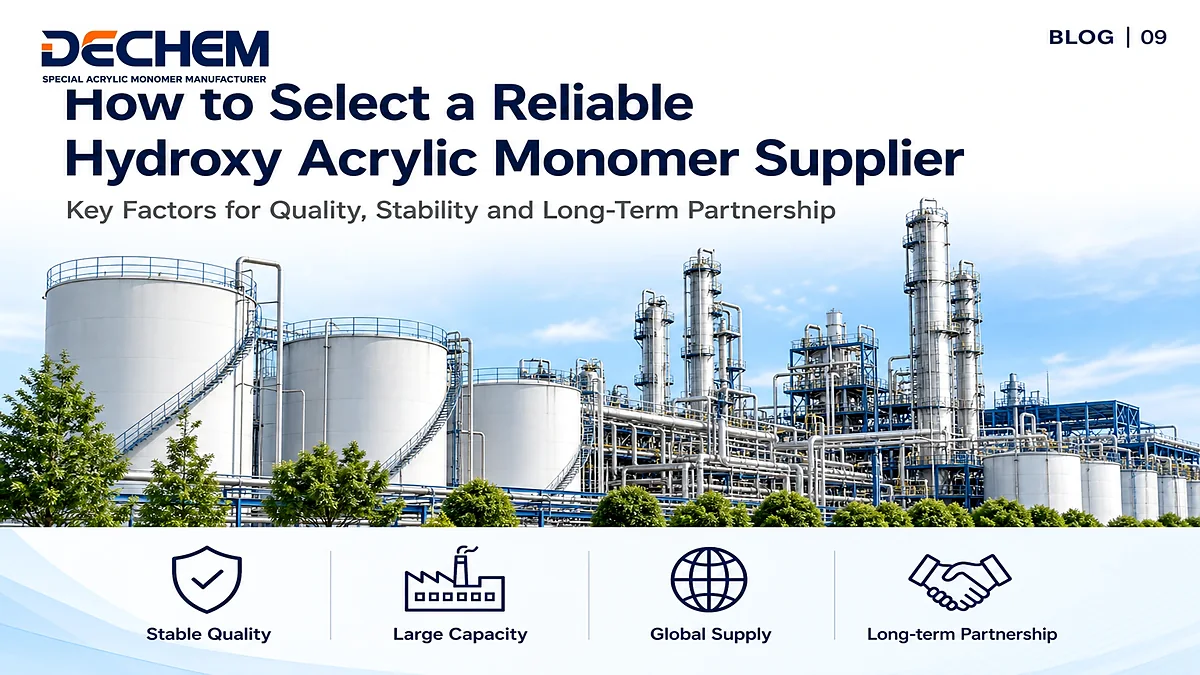
Choosing a supplier for a raw material that goes into your formulation is a long-term decision, and it deserves a structured approach rather than a price comparison.
1. Check the manufacturing setup, not just the catalogue
A supplier who lists the right CAS numbers is not yet a qualified supplier. Look for evidence of an actual production base: production lines, DCS process control, an in-house quality control laboratory, and warehousing. Ask for specifics — capacity, number of lines, how batch consistency is maintained. Vague answers are informative.
2. Verify the documentation chain
For each product you intend to buy, you should be able to obtain: a technical data sheet for the grade, a safety data sheet, and a certificate of analysis for the batch. Management system certificates should cover the operation that actually makes your material.
3. Ask how the export is handled
For a cross-border supply, ask what happens between the works and your warehouse. Which documents are prepared, which port is used, what is the standard lead time, and how is a demurrage risk managed. A supplier who can answer specifically has done it before.
4. Test before you commit
A sample is the cheapest part of the evaluation. Order a sample of the grade you intend to use, run your own testing against it, and compare with the TDS values. Do this for at least one production lot before moving volume.
5. Look at how information is presented
Product pages that state typical values and point to the official TDS are telling you something useful. Pages that quote prices, show stock counters, or promise free samples should be treated with care — those are not chemical supply practices.
6. Confirm the response path
Before placing an order, make sure you know who answers the technical question, and who confirms the commercial terms. For a B2B raw material relationship, a single named contact who understands your application is worth more than a general enquiry inbox.