HPA vs HEMA in Electronic Adhesives: Reactivity, Hydrophilicity and Reliability Trade-offs
HPA and HEMA look interchangeable on a specification sheet but not in a sealed electronic assembly. How the acrylate/methacrylate bond and the propylene/ethylene spacer drive cure speed, water uptake, outgassing and isocyanate crosslink behaviour.
Both HPA and HEMA are hydroxyl-functional monomers used to add adhesion, polarity and crosslink sites to acrylate systems. On a specification sheet they look close enough to invite substitution. In an electronic assembly they behave differently enough that the choice should be deliberate.
This comparison is written for engineers formulating adhesives for display modules, semiconductor packaging and flexible circuits, where the decision is usually driven by cure speed, water uptake and long-term reliability rather than by cost alone.
The structural difference that drives everything
| HPA | HEMA | |
|---|---|---|
| Chemical name | Hydroxypropyl acrylate | Hydroxyethyl methacrylate |
| CAS (common commercial grade) | 25584-83-2 (mixed isomers); 999-61-1 (2-HPA) | 868-77-9 |
| Polymerisable group | Acrylate | Methacrylate |
| Pendant group | Propylene spacer, secondary hydroxyl | Ethylene spacer, primary hydroxyl |
| Functionality | Monofunctional | Monofunctional |
Two variables separate them: the acrylate versus methacrylate double bond, and the propylene versus ethylene spacer. Every practical difference follows from those two.
Cure speed and reaction control
Acrylates polymerise substantially faster than methacrylates. In a radical UV cure, an HPA-containing formulation reaches gel point sooner and develops green strength faster. For a takt-time-limited line, that is an advantage; it also means less oxygen inhibition time and better through-cure at the bond line edge.
Methacrylates trade speed for control. HEMA homopolymerises and copolymerises more slowly and more uniformly. Where the specification is tight on molecular weight distribution or on batch-to-batch consistency of a binder resin, HEMA is the easier monomer to control. It also resists spontaneous polymerisation better during storage, which is relevant when material sits in a dispenser or a drum for weeks.
Practical guidance: UV-cured adhesives that must fixture in seconds → HPA. Resins synthesised offline where reproducibility dominates → HEMA.
Water uptake and humid reliability
This is usually the deciding factor in sealed electronic assemblies.
Both monomers raise the hydrophilicity of the cured network, because both carry a hydroxyl group. But at equal hydroxyl content, HPA is the more hydrophobic of the two — the extra methyl on the propylene spacer reduces the concentration of polar groups per unit volume and reduces the accessibility of the hydroxyl to water.
Consequences in a damp-heat or 85/85 test:
- Lower equilibrium moisture content, therefore less swelling stress on a constrained bond line.
- Less haze and blushing in optical adhesives.
- Lower risk of hydrolysis-driven adhesion loss at the glass or oxide interface.
- Reduced ionic movement and therefore better insulation resistance retention.
HEMA, by contrast, is the more hydrophilic choice and is often selected precisely for that reason — for example where a hydrogel-like moisture uptake, high polarity or strong wetting of a difficult substrate is the point.
Shrinkage, stress and warpage
Both are monofunctional, so both contribute far less cure shrinkage than multifunctional diluents. The difference between them is second order compared with the difference between either and a triacrylate. If warpage is the dominant defect, the fix is reducing multifunctional content and filler loading, not switching between HPA and HEMA.
Outgassing and residue
For packaging and optical applications, condensable volatiles are a defect source. Neither monomer is a "high volatility" material in the way a light acrylate is, but residual unreacted monomer will migrate under thermal load.
HPA cures faster, which tends to leave less residual monomer at a given dose — an advantage for outgassing. HEMA's slower cure needs a longer dose or a post-bake to reach the same conversion. Both need the formulation's photoinitiator package and cure profile to be validated on the actual bond geometry.
Adhesion and interface behaviour
- On hydrated oxide, glass and ITO: both work through hydrogen bonding. HPA's secondary hydroxyl on a more hydrophobic spacer wets slightly differently; HEA, not HEMA, is the closer comparison for maximum polarity.
- On polyimide and other organic dielectrics: methacrylates often show better compatibility with the substrate chemistry. HEMA is commonly seen in formulations contacting PI.
- With isocyanate crosslinkers: the secondary hydroxyl of HPA reacts more slowly than the primary hydroxyl of HEMA. If a thermal crosslink step is part of the process, HEMA's primary -OH gives a faster, more complete reaction; HPA needs a higher bake temperature or a catalyst.
That last point is frequently overlooked and shows up as incomplete cure in reliability testing.
Handling and regulatory
Both are skin sensitisers and both require closed handling with appropriate engineering controls. Do not assume one is "the safe one" — check the SDS for the specific grade. HEMA is a well-known sensitiser in the dental and medical field, and many formulators have internal restrictions on it for that reason alone.
Selection matrix
| Requirement | Prefer |
|---|---|
| Fast UV fixture, high line speed | HPA |
| Lowest moisture uptake in a sealed module | HPA |
| Fast isocyanate crosslink in a thermal step | HEMA |
| Tight batch-to-batch reproducibility of a resin | HEMA |
| Highest polarity, strong wetting of difficult surfaces | HEMA (or HEA) |
| Lowest residual monomer at fixed dose | HPA |
| Compatibility with polyimide substrates | HEMA |
| Lowest cost per hydroxyl equivalent in bulk | Compare per batch; do not assume |
Recommendation
Do not substitute one for the other on a formulation that has already passed qualification. If a substitution is forced by supply, re-run adhesion after damp heat, cure conversion and outgassing — those three tests catch almost every real difference. Where the design is still open, start from the reliability requirement: sealed optical assembly → HPA; thermally crosslinked structural bond → HEMA.
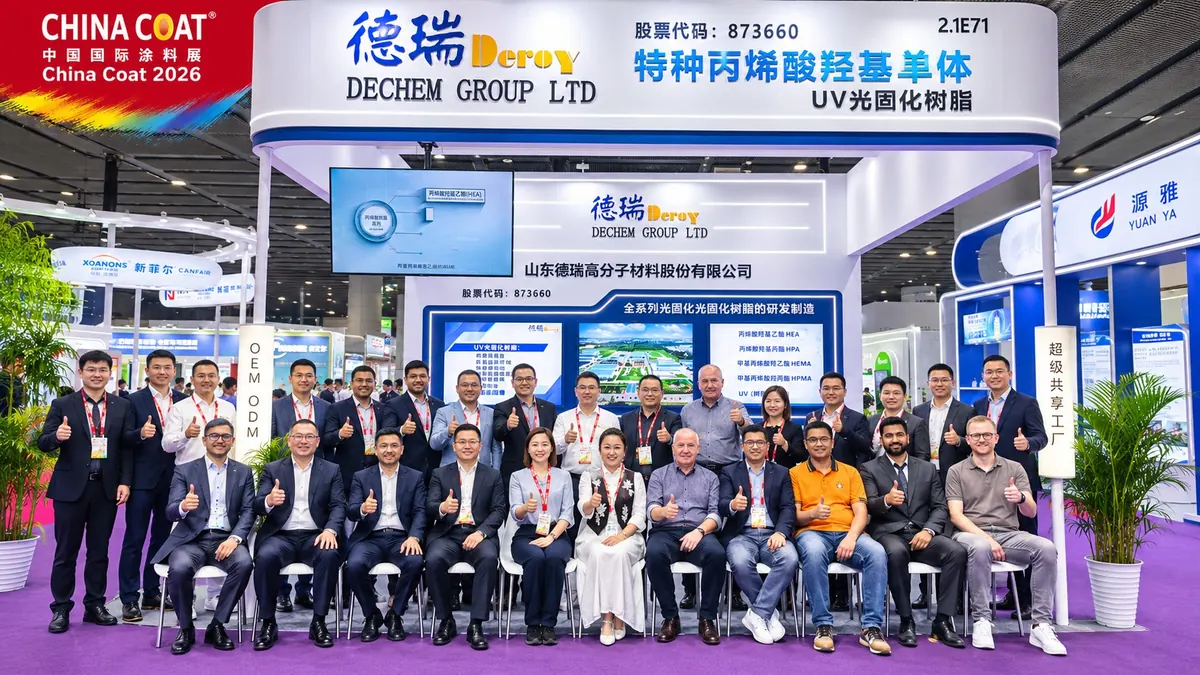
DECHEM supplies both HPA (CAS 25584-83-2) and HEMA (CAS 868-77-9) with batch COA, TDS and SDS. Ask for the comparison data pack and evaluation samples.