Hydroxyl-Functional Monomers in Acrylate Photoresist Binders: Adhesion and Alkali Developability
What hydroxyl-functional monomers actually do in an acrylate photoresist binder, why they do not provide alkali development on their own, and how to choose between HPA, HEA and HEMA.
A photoresist is usually described by its photoactive chemistry — DNQ-novolak, chemically amplified, or radical-cured acrylic. But the component that decides whether the film survives coating, baking, development and etch is the binder resin, and the binder is built from monomers chosen for three jobs at once: film formation, adhesion, and controlled solubility in the developer.
Hydroxyl-functional acrylate monomers such as hydroxypropyl acrylate (HPA), hydroxyethyl acrylate (HEA) and hydroxyethyl methacrylate (HEMA) are routinely evaluated for that second and third job. This note explains what they can and cannot do, so a formulator can judge whether they belong in a given binder.
What the binder has to deliver
Four properties decide whether a resist pattern resolves cleanly:
- Film integrity — the resin must form a uniform, pinhole-free coating at the target thickness and survive soft bake without dewetting or cracking.
- Adhesion — the film must hold on silicon, thermal oxide, silicon nitride and, in backend or display processes, on copper and aluminium, through wet development and rinse.
- Solubility contrast — exposed and unexposed areas must differ enough in dissolution rate to produce vertical sidewalls and acceptable film retention.
- Residue control — no scum in unexposed areas, no residue after development, and no leachable species that later contaminate the device.
Monomers are selected against these four, not against a single number on a datasheet.
Three routes to alkali developability — and where hydroxyl really sits
Aqueous development with TMAH-based developers requires acidic groups that ionise at the developer pH. In commercial practice there are three families:
- Phenolic hydroxyl (novolak, polyhydroxystyrene). Phenolic OH is acidic enough to dissolve in aqueous base, which is why DNQ-novolak and 248 nm resists are built on it.
- Carboxylic acid (acrylic or methacrylic acid, or anhydride-derived). The standard route in acrylate binders for display colour resists, dry film and photoimageable solder mask.
- Sulfonic acid and similar strong acid groups. Used where higher polarity or faster dissolution is needed.
Aliphatic hydroxyl — the group HPA and HEA carry — belongs to a different category. Its pKa is far higher than a carboxylic acid, so on its own it does not deliver meaningful dissolution in aqueous base. A binder built only on hydroxyalkyl (meth)acrylates will typically not develop cleanly at production speed.
That distinction matters, because it is frequently blurred in supplier marketing. Aliphatic hydroxyl contributes in ways that are still essential:
- Polar anchoring at the interface. The -OH group hydrogen-bonds to hydrated oxide and nitride surfaces, which is the mechanism behind the adhesion gain formulators report when hydroxyl monomers are added to an acrylate binder.
- Hydrophilicity modulation. Hydroxyl content tunes how fast the film wets and swells in the developer — too much and you get swelling, lift-off and pattern collapse; too little and development is slow and leaves scum.
- Crosslink sites. Hydroxyl reacts with blocked isocyanates, melamine-formaldehyde and epoxies during post-exposure bake or final cure, raising solvent resistance and thermal stability without adding a second development-active acid.
- Pigment and filler wetting. In colour resist and solder mask formulations, hydroxyl groups improve wetting and dispersion stability, which shows up as fewer coating defects.
In practice, hydroxyl monomers are used together with an acid-functional monomer: the acid provides development, the hydroxyl provides adhesion, wetting and cure latitude. Formulators tuning the ratio of the two is where most of the real work happens.
Choosing between HPA, HEA and HEMA
The three differ by spacer length and by whether the polymerisable group is an acrylate or a methacrylate.
| Monomer | Polymerisable group | Pendant group | Practical consequence |
|---|---|---|---|
| HEA | Acrylate | Ethylene (-CH2CH2OH) | Fastest copolymerisation; highest polarity per unit mass; strongest water uptake |
| HPA | Acrylate | Propylene (-CH2CH(CH3)OH) | One extra carbon; lower Tg contribution and lower water sensitivity than HEA, at similar hydroxyl functionality |
| HEMA | Methacrylate | Ethylene | Slower, more controlled polymerisation; better shelf stability of the resin; higher Tg contribution |
For electronics work, three selection questions usually decide it:
How much water uptake can the final film tolerate? Hydroxyl content raises moisture absorption. In a display or packaging layer where outgassing and dimensional stability matter, the more hydrophobic propylene spacer of HPA is often preferred over HEA at equal hydroxyl value.
How tight does the reactivity ratio need to be? Methacrylates give more uniform copolymer composition and better batch-to-batch consistency. If the binder is specified by a narrow molecular weight and composition window, HEMA is the easier monomer to control.
Is there a downstream cure step? If the layer is crosslinked after patterning, hydroxyl is a functional handle; if not, hydroxyl is mainly a polarity and adhesion choice.
Formulation trade-offs worth testing early
- Hydroxyl value versus acid value. Increasing hydroxyl raises adhesion and cure density but also water uptake and swelling in the developer. Increasing acid speeds development but erodes film retention and can attack the substrate.
- Molecular weight distribution. Low-molecular-weight fractions dissolve early and can cause scum and thickness loss in unexposed areas. Bimodal distributions from poor monomer feed control are a common root cause of inconsistent development.
- Inhibitor and ionic content. Hydroxy acrylates are supplied with an inhibitor to prevent spontaneous polymerisation. Residual inhibitor and trace metal ions matter at semiconductor grade. Ask for the batch COA and the ionic impurity data, and confirm the grade matches your cleanliness requirement.
- Storage and handling. These monomers are water-miscible and hygroscopic. Water pick-up shifts the effective composition and can cause haze or poor coating. Keep drums sealed, blanketed and within the supplier's stated temperature range.
Evaluation checklist before you commit a formulation
- Adhesion after development, not before — cross-cut or peel on the actual substrate stack (Si, SiO2, SiN, Cu, Al, PI), wet, after rinse and dry.
- Dissolution contrast — measure development rate of exposed versus unexposed film at your developer normality, not at a generic condition.
- Film retention and sidewall angle at the smallest feature you need.
- Residue and scum by optical inspection plus surface analysis if the layer is electrically active.
- Reliability — outgassing, water uptake and thermal stability through the downstream bake or reflow the part will actually see.
Sourcing note
Hydroxypropyl acrylate is available as the mixed-isomer grade (CAS 25584-83-2) and as the single-isomer 2-HPA (CAS 999-61-1); the two are specified separately and should not be substituted without evaluation. Confirm the grade, isomer basis, inhibitor level and ionic specification on the COA before locking a formulation, and keep the CAS number consistent across TDS, SDS, COA and purchase documents.
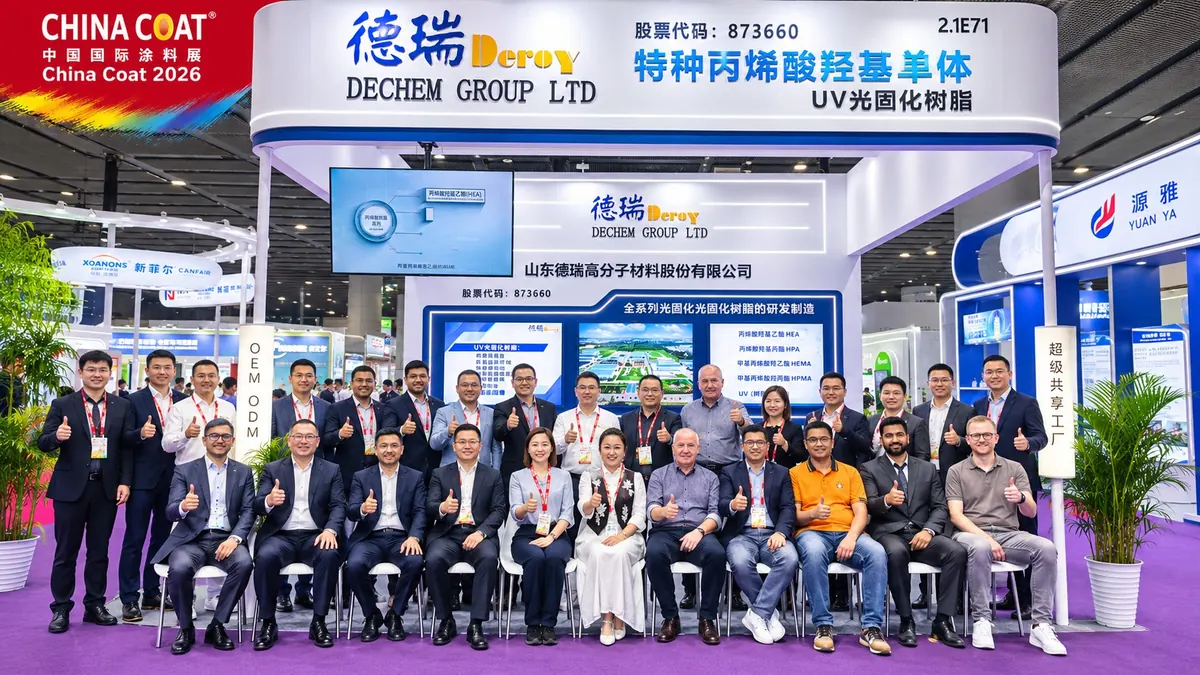
DECHEM supplies HPA, HEA, HEMA and HPMA with batch COA, TDS and SDS, and can discuss grade and packaging requirements for evaluation quantities. Request a specification sheet and sample.