Which Functional Groups Make a Binder Resin Alkali-Developable?
Aqueous development depends on acidity relative to developer pH, not on polarity in general. Why carboxylic acid and phenolic hydroxyl dissolve in dilute base while aliphatic hydroxyl does not, and what hydroxyl monomers contribute instead.
Aqueous development is the step where a photoresist either becomes a working pattern or a defect source. It is governed by one property of the binder resin: how fast it dissolves in dilute base, and how much that rate changes between exposed and unexposed areas.
Not all "polar" groups are equal here. Choosing the wrong one is the most common reason a formulation develops poorly despite having plenty of functional monomer in it.
The governing principle: acidity, not polarity
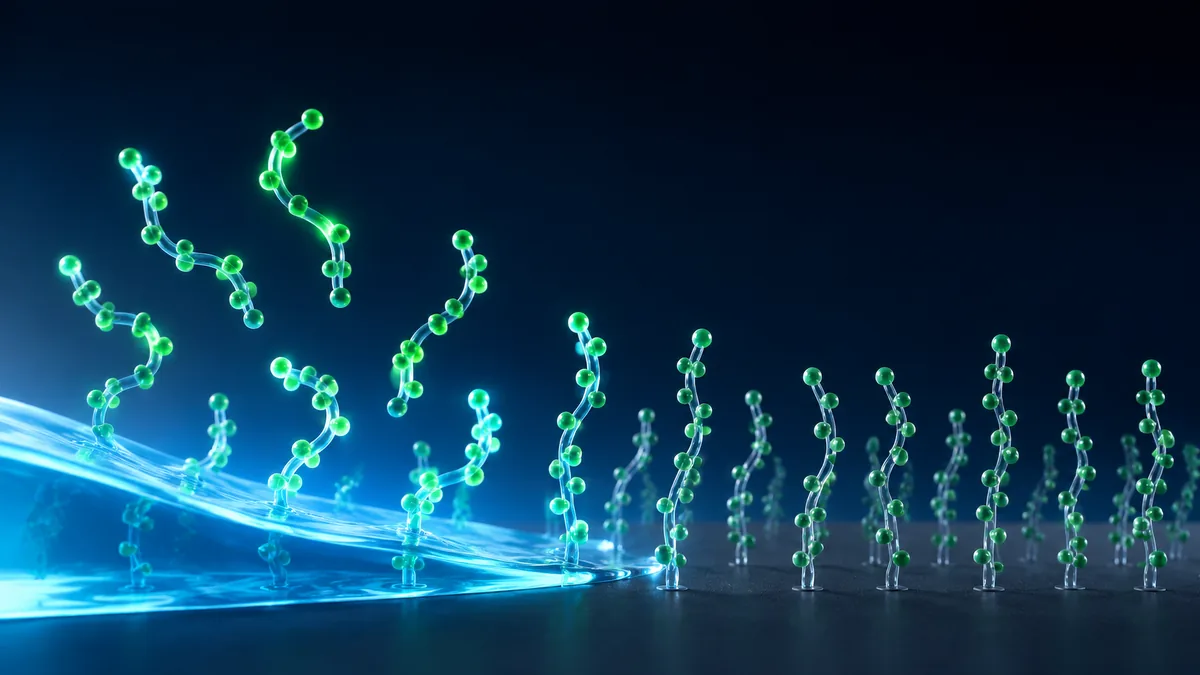
Aqueous base development works by ionising acidic groups on the polymer, which makes the chain water-soluble. What matters is whether the group's pKa sits below the pH of the developer.
- A carboxylic acid (pKa typically in the 4–5 range) ionises readily in dilute aqueous base. This is why acrylic and methacrylic acid are the workhorses of alkali-developable acrylate systems.
- A phenolic hydroxyl (pKa around 10) is weakly acidic but still ionises in the strongly basic developers used in novolak/DNQ and polyhydroxystyrene systems. This is the basis of conventional positive resists.
- A sulfonic acid or similar strong acid group ionises across almost the whole practical pH range and is used where high polarity or fast dissolution is required.
- An aliphatic hydroxyl — the group carried by HPA, HEA and HEMA — has a pKa in the mid-teens. It does not ionise meaningfully in a TMAH or potassium hydroxide developer.
That last point deserves emphasis because supplier literature often lists "hydroxyl-functional" alongside "alkali-soluble" as if they were the same claim. They are not.
What each group actually does
| Group | Contributes to dissolution | Other roles |
|---|---|---|
| Carboxylic acid | Primary driver | Adhesion to oxide and metal, pigment wetting; too much causes swelling, image collapse, attack on substrate |
| Phenolic hydroxyl | Primary driver in phenolic systems | Thermal stability, dry-etch resistance (in novolak), but poor transparency at short wavelengths |
| Sulfonic acid / strong acid | Primary driver | High polarity, fast development; can be too hydrophilic and cause scum or footing |
| Aliphatic hydroxyl | Marginal on its own | Adhesion via hydrogen bonding, hydrophilicity tuning, crosslink site for post-bake, wetting of pigment and filler |
| Epoxy, amide, ester | Negligible | Adhesion, mechanical properties, cure chemistry |
So why is hydroxyl still in almost every formulation?
Because development is only one of four jobs. A binder that develops perfectly but does not adhere, or that swells so much it collapses fine features, is not usable. Aliphatic hydroxyl contributes to the other three:
Adhesion. Hydroxyl groups hydrogen-bond to hydrated oxide, nitride and metal surfaces. After development and rinse, the difference in adhesion between a hydroxyl-containing and a hydroxyl-free binder is usually visible in a simple tape or peel test.
Hydrophilicity control. Hydroxyl content sets how fast the film wets and swells in the developer. This is a tuning knob: increasing it accelerates development slightly and improves wetting, but also increases swelling, which drives pattern collapse and thickness loss in unexposed areas.
Post-development cure. If the layer is baked or crosslinked after patterning, hydroxyl is the reactive handle for blocked isocyanate, melamine-formaldehyde or epoxy. Without it the layer stays thermoplastic, which is why hydroxyl monomers appear in permanent layers such as overcoats and insulation films far more than in pure imaging resists.
Wetting of pigments and fillers. In colour resists and solder masks, hydroxyl improves dispersion stability, which reduces coating defects and improves colour uniformity.
How the balance is set in practice
Formulators work with two numbers:
- Acid value — sets the development rate and the minimum feature size that can be resolved.
- Hydroxyl value — sets adhesion, cure density and water uptake.
Raising acid value speeds development and improves contrast until swelling overtakes it; raising hydroxyl value improves adhesion and cure latitude until water uptake and swelling dominate. The useful operating window is narrow, and it depends on developer strength and temperature, film thickness and the smallest feature in the design.
Three consequences worth planning for:
Developer strength is part of the specification. A binder tuned for a standard TMAH developer behaves differently at higher normality. Confirm the developer concentration and temperature with the process owner before finalising the resin.
Film thickness changes the optimum. Thick films need faster dissolution at the surface but suffer more from swelling at the base. A binder that works at 2 µm may fail at 10 µm.
Contrast is more important than absolute rate. What determines sidewall quality is the ratio between exposed and unexposed dissolution rates, not the raw speed of either.
Evaluation checklist
- Dissolution rate of unexposed film at your developer concentration — this predicts dark-film loss.
- Dissolution contrast (exposed/unexposed ratio) — this predicts sidewall angle.
- Swelling — measure film thickness in the developer over time, not only before and after.
- Residue and scum in unexposed areas after development.
- Adhesion after development on the real substrate stack.
- Post-bake behaviour if the layer is crosslinked — hydroxyl conversion, solvent resistance.
Practical takeaway
Design the acid monomer for development and the hydroxyl monomer for adhesion, wetting and cure. Treat them as two separate decisions, and do not expect an aliphatic hydroxyl monomer to make a binder developable — it will not. Where a formulation is stuck between poor adhesion and excessive swelling, the fix is usually to rebalance acid value down and hydroxyl value up, rather than to change either monomer class.
DECHEM supplies HPA, HEA, HEMA and HPMA for binder and resin synthesis, with batch COA, TDS and SDS. Request specifications or discuss a grade for your system.