2-HEA vs 2-HPA vs HEMA vs HPMA: Monomer Selection Guide
How to choose between 2-HEA, 2-HPA, HEMA and HPMA for UV-curable coatings: hydroxyl value, cure speed, Tg, adhesion, water uptake and handling.
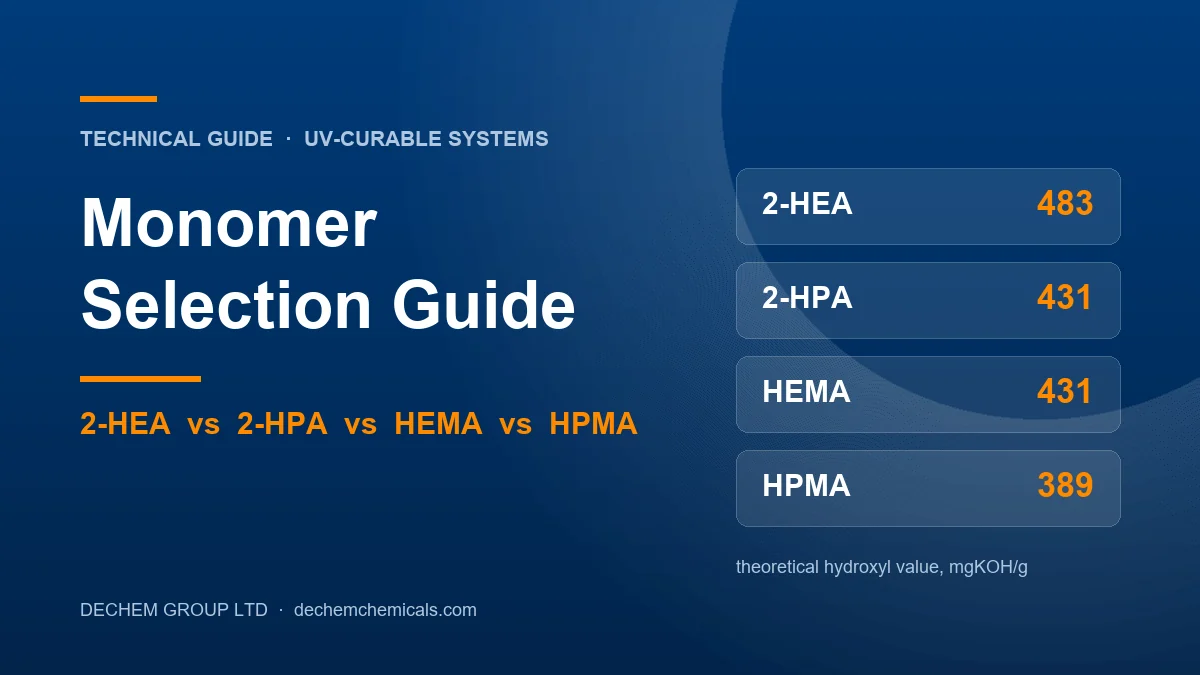
Four product data sheets, four hydroxyl values, four prices per kilogram. On paper 2-HPA and HEMA look almost interchangeable — same molecular weight, same hydroxyl value — and 2-HEA looks like the cheap high-hydroxyl option. Formulators who select on that basis usually come back with one of two complaints: the coating cures too slowly, or the film is too brittle after ageing.
Neither is a quality problem. Both are selection problems.
What the hydroxyl group does in a UV system
The acrylate double bond carries the cure. The hydroxyl group does a different job:
- Adhesion to polar substrates. Hydrogen bonding to metal, glass and many plastics — the reason hydroxyl-functional monomers appear in coatings that stick where pure acrylates fail.
- Crosslink sites for dual-cure. Where UV cure is combined with isocyanate or melamine chemistry, hydroxyl value sets the stoichiometry. Get it wrong and the second stage either under-cures or leaves free isocyanate.
- Glass transition and hardness after cure.
- Modest reduction of oxygen inhibition at the film surface.
The practical rule: choose the backbone for cure speed and Tg, then choose the grade for hydroxyl value. Doing it in the reverse order is the most common source of rework.
Side-by-side comparison
| Monomer | Molecular weight | Theoretical OH value, mgKOH/g | Homopolymer Tg |
|---|---|---|---|
| 2-HEA (acrylate) | 116.12 | ≈ 483 | low |
| 2-HPA (acrylate) | 130.14 | ≈ 431 | low to moderate |
| HEMA (methacrylate) | 130.14 | ≈ 431 | high |
| HPMA (methacrylate) | 144.17 | ≈ 389 | moderate to high |
Theoretical hydroxyl value is 56100 × functionality / molecular weight for a monofunctional monomer. Commercial grades carry a supplier-specific tolerance band, so the calculated figure is a cross-check, not a specification — work from the COA.
Tg is given as a ranking rather than as absolute figures: reported homopolymer values move with the measurement method (DSC vs DMA), heating rate and molecular weight. Use the grade TDS when you need a design input.
The trap: same hydroxyl value does not mean interchangeable
2-HPA and HEMA share a molecular weight of 130.14 and therefore the same hydroxyl value. They are not substitutes. The acrylate propagates faster under UV and gives better adhesion and flexibility, with more shrinkage and a stronger odour. The methacrylate cures more slowly but delivers higher hardness, better weathering and a less tacky surface.
Swapping one for the other on hydroxyl value changes cure speed, hardness and shrinkage at the same time — three variables moving at once, with no way to tell which one caused the failure. If a substitution is unavoidable, change one property at a time and re-run the cure-speed and adhesion tests.
Decision path
Cure speed is the bottleneck: 2-HEA
The highest hydroxyl value and the fastest reactivity of the four. Typical use is as a reactive diluent where viscosity has to come down without losing crosslink density, or where line speed is limited by cure. Two things to watch: water sensitivity (it is hygroscopic) and handling controls (it is a recognised skin sensitiser).
Adhesion to plastic plus flexibility: 2-HPA
The usual choice for coatings on ABS, PC and PVC where 2-HEA makes the film too water-sensitive and HEMA makes it too hard. Lower water solubility than 2-HEA, better flexibility than the methacrylates.
One parameter to verify: commercial 2-HPA is an isomeric mixture of primary and secondary hydroxyl isomers. The secondary hydroxyl reacts more slowly with isocyanate in dual-cure systems, so the isomer ratio affects the second-stage cure. Ask for it in writing; it is not always on a standard TDS, and it differs between suppliers.
Hardness and weathering: HEMA
The workhorse for hard UV coatings and a common adhesion promoter where both hardness and polar-substrate bonding are needed. Higher Tg means harder films at the same crosslink density, paid for in cure speed and flexibility.
Hardness with lower water uptake: HPMA
The most hydrophobic of the four. Where HEMA gives acceptable hardness but the cured film picks up too much moisture — or where gloss retention under humid conditions matters — HPMA is the usual move. The trade-off is the lowest hydroxyl value of the set, so more monomer is needed to reach the same crosslink density.
Where each grade usually ends up
- 2-HEA — waterborne emulsions and dispersion resins, pressure-sensitive adhesives, photopolymer and 3D-printing resins, textile and paper coatings, reactive diluent in UV inks.
- 2-HPA — UV coatings for plastics, adhesives, overprint varnishes, systems needing flexibility plus adhesion.
- HEMA — hard UV coatings, dental and medical resins, emulsion polymerisation, adhesion promotion in metal coatings.
- HPMA — coatings and inks requiring water resistance, industrial topcoats, adhesives for humid service conditions.
These are typical placements, not limits. The final choice should come from your own cure-speed, adhesion and ageing data on the actual substrate. The full monomer range is listed with CAS numbers and packaging options.
Formulation and handling mistakes worth avoiding
- Assuming "inhibited" means "needs no air". MEHQ — the inhibitor in most of these grades — only works with dissolved oxygen present. Nitrogen blanketing removes it and the batch gels in the drum. Keep an air headspace unless the supplier states the grade is stabilised for inert conditions.
- Topping up inhibitor without measuring. Extra MEHQ pushes the level above specification and slows surface cure. Measure first; the COA gives the level as shipped.
- Ignoring water content in 2-HEA. A hygroscopic grade drawn from a drum open for weeks will haze, shift colour and lose cure speed. Karl Fischer before use, not after a failed batch.
- Overloading the high-Tg monomer to chase hardness. Crosslink density and Tg both rise, shrinkage rises with them, and adhesion falls.
- Storing above ambient in sunlight. Heat and UV both consume inhibitor. Keep drum and IBC stock cool, shaded and rotated.
Qualifying a sample in two weeks
| Check | Method | What it tells you |
|---|---|---|
| Hydroxyl value | Titration | Whether the batch matches the COA, and dual-cure stoichiometry |
| Purity and isomer ratio | GC | Volatile impurities; for 2-HPA, the primary/secondary split |
| Water content | Karl Fischer | Handling damage — critical for 2-HEA |
| Inhibitor level | HPLC | Whether storage life suits your climate |
| Colour | Pt-Co / APHA | Ageing, and suitability for clear coats |
| Cure response | RT-FTIR or pendulum hardness | Real cure speed on your line, not the catalogue claim |
| Adhesion | Cross-hatch, ISO 2409 | The property most often misjudged from a TDS |
| Ageing | QUV or 500 h at 50 °C | Yellowing, gloss retention, embrittlement |
Two weeks is enough to run this on one substrate with one formulation. It is cheaper than a failed production batch.
FAQ
Is 2-HPA a drop-in replacement for HEMA?
No. Same molecular weight and hydroxyl value, different chemistry. Acrylate versus methacrylate changes cure speed, hardness and shrinkage at the same time. Re-formulate and re-test.
Which of the four has the highest hydroxyl value?
2-HEA, at approximately 483 mgKOH/g, because it has the lowest molecular weight of the set. HPMA is the lowest at approximately 389 mgKOH/g.
Can all four be used in waterborne systems?
2-HEA is the practical choice for aqueous systems. 2-HPA is limited, HEMA moderate, HPMA low. In emulsion polymerisation, HEMA and HPMA are normally used as functional comonomers rather than as the aqueous-phase component.
Do I need to add inhibitor on receipt?
No, if the COA states an inhibitor level. Verify it, store cool, keep oxygen present. Adjust only if your own stability data shows depletion.
Why did my drum gel during storage?
The usual causes, in order: nitrogen blanketing or a sealed headspace with no oxygen, storage above 30 °C or in direct sunlight, contamination with peroxide or metal ions from a previously used pump, expired stock.
What documents should I request with a quote?
A COA for the actual batch, not a generic specification sheet; SDS in the required language; GC purity data; water content; inhibitor level; colour; and the current REACH registration status for the grade as supplied.
Sourcing checklist
- Grade and CAS confirmed in writing, not just in the product name
- COA tied to the batch number you will actually receive
- Inhibitor type and level stated
- Water content and colour specified with limits
- Isomer ratio stated for 2-HPA
- SDS and REACH status current
- Packaging agreed: drum, IBC or ISO tank, with headspace and gasket details
- Shelf life and storage temperature in writing
- Retained sample from the same production batch as the bulk order
Need a sample and the COA behind these numbers? Request a sample — tell us the substrate, cure system and target Tg, and we will send the grade that fits rather than the whole catalogue.